|
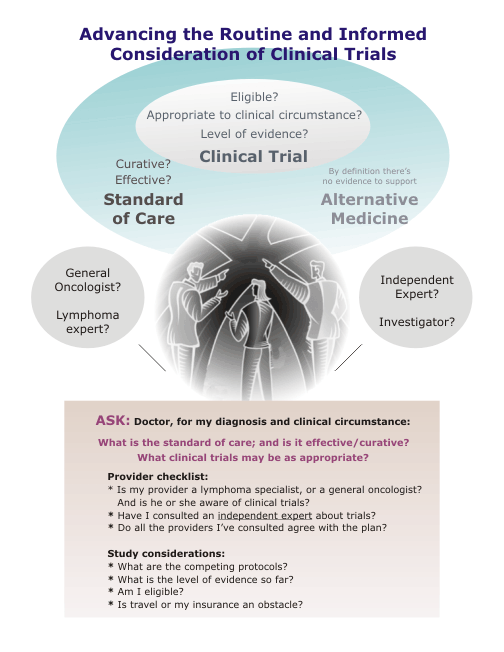
Guidelines at Diagnosis | About Clinical Trials |
|
|
evidence-based support and information |
|
|
|
|
|
||||||||||||||||||||||||||||||||||||||||||||||||||||||||||||||||||||||||||||||||||||||||||||||||||||||||||||||||||||||||||||||||||||||||||||||||||||||||||||||||||||||||||||||||||||||||||||||||||||||||||||||||||||||||||||||||||||||||||||||||||||||||||||||||||||||||||||||||||||||||||||||||||||||||||||||
.gif) |
What is the purpose of the study? |
|
How might I benefit from participating? |
|
What are the risks from participating? |
|
What were the results of other studies of this treatment? |
|
What other treatments could I receive if I don't take part in the study? |
|
How do the risks and potential benefits of the study compare with the standard of care for my clinical circumstance? |
If I join the study:
|
How am I protected from possible adverse events? |
|
What tests are in the study, and how often are they given? |
|
Can I decide to stop participating at any time? (Yes, you can) |
|
Will I continue to see my current doctor? |
|
How will participating effect daily activities? Will I still be able to work or go to school? |
|
Will I have to be in the hospital? How many days? |
|
What are the possible risks or side effects for me? |
|
Will my insurance cover procedures and tests? |
|
Will there be extra costs because of the study? |
|
How will I be checked after the study, and how often? |
|
How long will the study last and how long will I be tested? |
|
Will I be made aware of the results? |
Side effects and uncertainty about them are not unique to clinical trials.
Here are important points about side effects that may apply to studies.
|
The study doctors do not know who will or will not have side effects. |
|
Some side effects may go away soon, some may last a long time, or some may never go away. |
|
Some side effects may interfere with your ability to have children. |
|
Some side effects may be serious and may even result in death. |
Here are important points about how you and the study doctor can make side effects less of a problem:
|
Tell the study doctor if you notice or feel anything different so they can see if you are having a side effect. |
|
The study doctor may be able to treat some side effects. |
|
The study doctor may discontinue or adjust the dose of the treatment to try to reduce side effects. |
|
"half of the unpublished trials have failed to accrue and reach endpoints; |
|
Nearly 60% of trials opened for 5 years had fewer than five patients enrolled at each site, and, for >20% of studies, not a single subject had been accrued. |
|
of all NCI phase I, II, and III trials opened and closed between 2000 and 2007,
|
|
So, while perhaps only one in five cancer clinical trials is ever published,
|
|
Survey Reveals Blood Cancer Patients Not Being Directed to Clinical Trials Despite
|
|
Lymphoma Expert Calls for Focus on Clinical Trials http://bit.ly/fayxR9
|
|
A National Cancer Clinical Trials System for the 21st Century: Reinvigorating the NCI Cooperative Group Program http://bit.ly/a2rUEh
|
|
Faltering Cancer Trials nytimes.com April 2010
|
|
Cure Magazine: The Treatment Option You May Be Missing http://bit.ly/bItRI7 |
|
Progress and Deficiencies in Clinical Trial Reporting http://bit.ly/a9ffVv
|
PATIENT SURVEY (completed)
To identify obstacles to participating in clinical trials, and find remedies:
Interests, Attitudes, and Participation in Clinical Trials Among Lymphoma Patients With Online Access
|
Patient Survey on attitudes and participation in trials Web-based (closed) |
||
|
Poster exhibit PDF (accepted L&M Conference)
|
||
|
ASCO 2009 JCO |
Discussion: Patient issues and perceptions regarding randomization, study risk, eligibility, and tests and procedures suggest an opportunity to improve enrollment in clinical trials by focusing on these aspects of study design, specifically, attending to the rationale of the protocol as a treatment decision – having the potential to optimally meet the clinical needs and treatment goals of the participants, in addition to answering important clinical questions.
ONCOLOGIST SURVEY (open)
To identify obstacles to the routine consideration of clinical trials:
|
Confidential CLINICAL TRIAL SURVEY |
|
Raw data (preliminary n = 51) |
|
Raw data PDF |
|
Most commonly cited obstacles so far (n=51) Chart PDF |
|
Most significant obstacles so far Chart PDF |
CLINICALTRIALS.GOV - in need of an upgrade! (open)
To make ClinicalTrials.gov searchable by clinical circumstances and goals:
|
Our proposal to NIH ClinicalTrials.gov group PDF |
|
Free brochure on this project for printing and distribution: |
|
Presentation on participation issues to industry and investigators: |
|
Questions that Can Be Only Answered by Clinical Trials PDF |
There's an abundance of rationally designed promising new agents, which need to be tested as single agents, but also with existing protocols. However, the pool of patients considering clinical trials remains very low, therefore studies failing to reach enrollment goals are increasing as the number of promising agents increase.
It's as if you have a small pond with 100 fish, and a growing number of fisherman (once 10, now 20) testing new lures. Each contestant making it more difficult to know which if any is truly effective, useful, or best for which type of fish.
A marker for this was the prevalence of N=6, N=10, N=20 in presented clinical data. Such small populations, while customary in early phase studies, contributing to missed signals of benefit and risk. Low enrollment and delays in enrollment causing sponsors to reconsider if the investment is worth while - could ever lead to marketing approval.Conclusion: We urgently need to increase the pool of patients considering clinical trials by providing new tools and clinical practice policies.
DRAFT - requires revision
|
Our proposal to Enhance ClinicalTrials.gov - make searchable by clinical circumstances PDF |
|
Brochure: The Urgent Need to Increase Participation in Clinical Trials PDF |
|
Patient attitudes and interests in Trials - Our Poster Exhibit PDF |
|
Questions that Can Be Only Answered by Clinical Trials PDF |
|
Harmonize research objectives with meeting clinical needs and treatment goals
|
Action: Encourage sponsors to consult informed patients, such as scientists with the disease, when designing clinical trials.
Action: Visualize the study protocol from the patient’s point of view – with an appreciation that patients have one life to experiment with.
Does the protocol compare favorably to other options in this setting?
Does it unnecessarily include tests that patients fear, such as bone marrow biopsies?
Do the side effects preclude the use of treatments that may be needed later?
Does the protocol include quality of life endpoints?
Is there genuine uncertainty about which treatment arm in a randomized trial is best?
Can you disclose outcome data as it develops, to foster trust?
Are predictive tests used to identify who is likely to benefit, such as gene profiling? *
“Given the number of articles that describe the correlative and predictive usefulness of array-based molecular classifications, especially in leukemias, these outcomes no longer elicit surprise. But perhaps they should — not only because of their clinical usefulness, as outlined in the editorial by Grimwade and Haferlach (pages 1676–1678), but also because of the rapid pace at which expression genomics is changing the conduct of clinical research.”
NEJM ~ Vol. 350:1595-1597, April 15, 2004 No 16
Also see Patient perspectives on clinical trial design
|
Make it easier for doctors and patients to locate trials appropriate to the patients clinical setting and treatment goals ... See Narrative of Poster exhibit for details: PDF |
||||
|
Provide financial support for travel, lodging, and associated tests.
|
|
Action: Advocate for government assistance, especially for the uninsured, so that the financial limitations of individual patients do not impede progress or access to appropriate investigational therapies. See Coverage of Health Care Costs for Clinical Trials - How does your state measure up? |
|
Action: Educate patients about resources that can help patient to overcome these obstacles, |
|
Carry out the blueprint for the National Biospecimen Network
|
|
Standardized collection of biospecimens; |
|
Find novel targets using microarrays; |
|
Refine diagnosis and identify high- and low-risk disease; |
|
Find clinically useful biomarkers by identifying correlations between gene expression profiles and responders; |
|
Select the appropriate patients for targeted-phase studies. The result is that smaller studies will be needed to achieve statistically significant results, providing relief from the competition for patients. Fewer patients will be subjected to the toxicity of drugs that cannot help them. The new favorable circumstances – replacing trial and error – will cause increased interest in trials and cancer research among patients, investigators, and commercial entities... See background on National Biospecimen Network |
|
Action: Help patients and physicians to locate appropriate studies by:
|
||||||
|
Action: Provide community physicians with incentives for referring patients to clinical trials. |
||||||
|
Action: Involve community physicians in the administration of clinical trial protocols. |
||||||
|
Action: Educate patients about the true risks of the disease, the potential of investigational treatments, and the limitations of standard therapies. See, for example About Lymphoma |
||||||
|
Action: Encourage patients to consult lymphoma experts to get objective opinions about investigational therapies. See Doctors page. |
||||||
|
Action: Advise patients to have the experts they consult contact their treating physicians in order to reach a consensus on what treatment protocol is best for them. |
||||||
|
Action: Help patients to review consent forms, contact investigators, and complete applications. |
||||||
|
Action: Inform patients on how to better evaluate medical claims and data. |
|
Create innovative trial designs with the potential to make a positive difference in patients' lives
|
|
Action: Develop front-line protocols, combining aggressive approaches in combination and/or in sequences with biological and immune-based therapies, that provide the potential for curing or extending survival in difficult to treat lymphomas. |
|
Action: Develop front-line protocols for indolent lymphomas that combine or sequence low toxic target biotherapies and immune-based therapies with the goal of managing the disease with minimal toxicity. |
|
Action: Develop protocols that induce active immunity against tumor antigens, and that may overcome ways that tumors escape or suppress immunity. |
|
Action: Reduce reliance on quick response agents when the responses are not durable and the side effects, such as myelosuppression, contribute to complications and limit future options. |
|
Action: Develop protocols for refractory end-stage disease that can extend survival while improving quality of life. |
 Topic Search: Clinical Equipoise (genuine uncertainty in randomized studies)
 |
The Urgent Need to Increase Participation in Clinical Trials PDF |
|
Cancer Trial Participants Rarely Told of Results Medscape (free login req.)
|
|
Clinical Trials of Interest for Lymphoma |
|
Coverage of Health Care Costs for Clinical Trials - How does your state measure up? |
|
Consult with outside experts |
|
Evaluating Medical Claims and Data |
|
Finding lymphoma clinical trials, made easier |
|
National Biospecimen Network |
|
Patient perspectives on clinical trial design |
|
Review the article: Experimental Therapy, End-of-Life Care Can Coexist
|
|
Travel for Treatment Lymphomation.org |
|
Obstacles to the accrual of patients to clinical trials in the community setting. Winn RJ.
|
|
Things you can do to get your health insurance to cover a clinical trial cancer.gov ... still an issue until 2014, when the Health Care Reform measure kicks in. |
|
Understanding the attitudes of the elderly towards enrolment into cancer clinical trials http://www.ncbi.nlm.nih.gov/pmc/articles/PMC1382233/?tool=pmcentrez
|
|
Barriers in phase I cancer clinical trials referrals and enrollment: five-year experience at the Princess Margaret Hospital ncbi.nlm.nih.gov |



 Geographic Search by